~70%
About 70% fewer tokens compared to direct AI coding
Initializing Contract Coding pipeline...
The contract is the single source of truth. Code is generated consistently and remains fully controllable.
Contract Coding is not just AI coding. It is a software development approach where the contract serves as the source of truth, every change starts from the contract, then gets compiled into code that is reproducible and traceable.
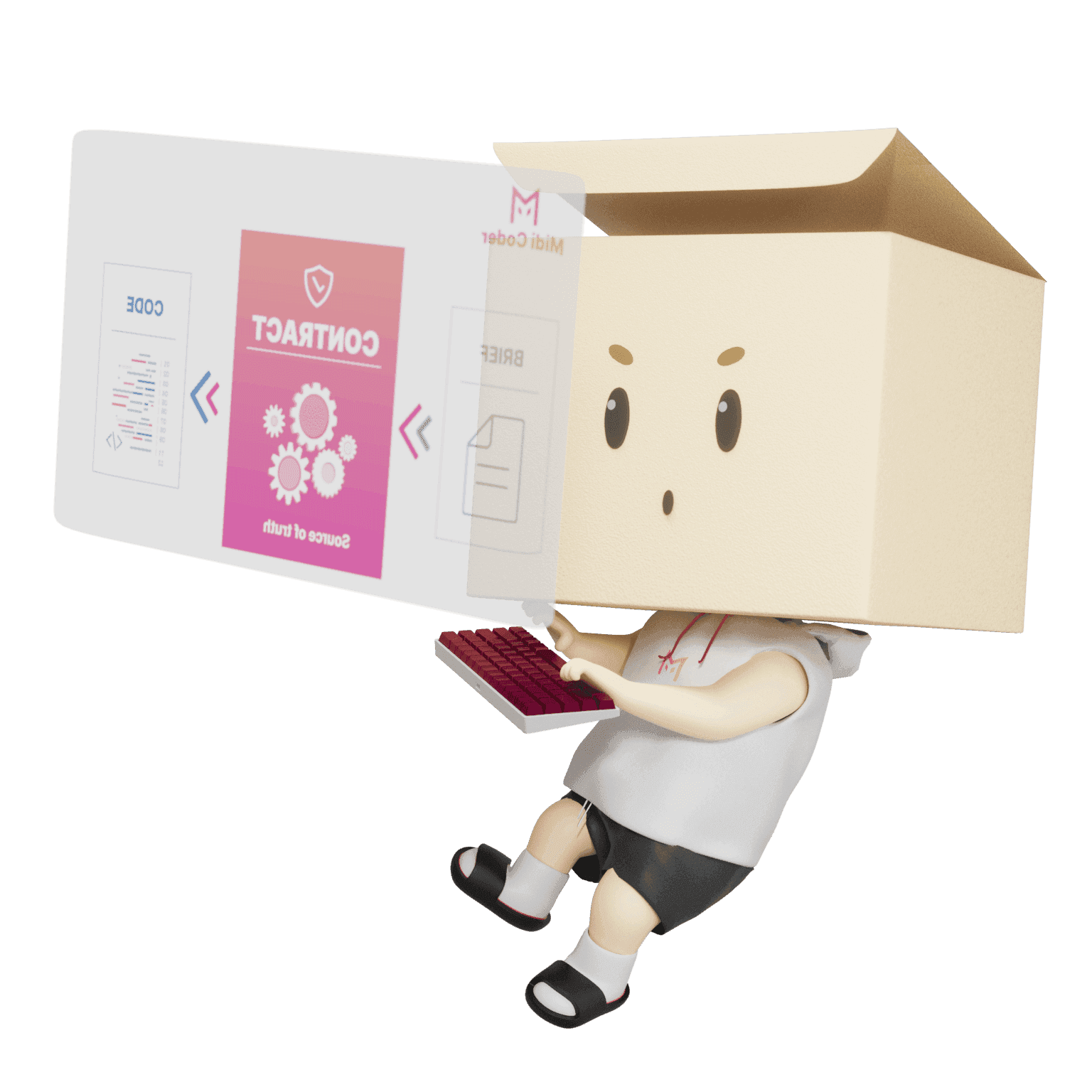
Contract Coding is an AI-assisted software development approach where the contract acts as a structured specification layer between requirements and source code. Instead of letting AI modify the codebase directly, all change go through the contract — where they are controlled, compiled, and turned into code through a consistent pipeline.
This approach makes AI-driven development easier to review, easier to trace, and more stable, especially as systems grow in complexity, with more modules, rules, and contributors involved.
Learn more about Contract Coding →About 70% fewer tokens compared to direct AI coding
About 90% fewer prompt-edit-run iterations
Remains stable even as systems grow in complexity
All changes are anchored to the contract, making them easy to review and trace
The difference lies in where changes originate, how they enter the codebase, and how well they remain controlled as the system scales.
| Criteria | Vibe Coding | Contract Coding |
|---|---|---|
| Source of control | Prompt + direct code edits | Contract as the single source of truth |
| Change flow | Prompt -> direct changes in the codebase | Contract -> IR -> compiler -> code (through a controlled pipeline) |
| Repeatability | Depends on prompts, results vary across runs | Stable output when contract and pipeline remain unchanged |
| Traceability | Hard to trace back to original intent | Fully traceable through contract, version, and related rules |
These issues appear early when prompt and direct code edits become the center of the workflow.
When changes start from prompts and scattered manual edits across multiple files, teams gradually lose clarity on which rules should persist over time.
When editing code directly, AI can easily cross module boundaries, causing the system architecture to drift away from its original design.
Pull requests may still work, but teams struggle to understand why changes were made, what decisions led to them, and what impact they have.
Every change starts from a clear description of system behavior, is standardized into a contract, and goes through a compilation pipeline before entering the codebase
AI, developer, or teams describe system behavior clearly — including the requirements, rules, and intended outcome.
Midi Coder transforms this description into a structured contract — serving as the primary control layer of the system.
The contract goes through a compilation pipeline to generate consistent, repeatable, and controlled code.
Code is applied to the codebase through the pipeline, instead of being manually edited file by file by AI.
A real contract typically consists of multiple files, layers, and related artifacts.
routes: - method: POST path: /api/v1/matches command: CreateMatch description: Create a new match and enter matchmaking queue auth: jwt request_schema: - name: user_id type: string required: true response_schema: - name: match_id type: string required: true tags: - matchmaking - method: POST path: /api/v1/matches/{id}/move command: MakeMove description: Make a move in an active match auth: jwt request_schema: - name: move type: string required: true description: Chess move notation response_schema: - name: game_state type: json required: true description: Updated game state after move tags: - gameplay - method: POST path: /api/v1/matches/{id}/resign command: ResignMatch description: Resign from current match auth: jwt request_schema: - name: user_id type: string required: true response_schema: - name: result type: string required: true tags: - gameplay - method: GET path: /api/v1/matches/{id} query: GetMatch description: Get match details by ID auth: jwt response_schema: - name: match_id type: string required: true - name: player_white type: string required: true - name: player_black type: string required: true - name: status type: string required: true - name: result type: string required: false tags: - matches - method: GET path: /api/v1/users/{user_id}/matches query: GetUserMatches description: Get all matches for a user auth: jwt response_schema: - name: matches type: list<json> required: true tags: - matchescommands: - id: CreateMatch description: Create a new match and add to matchmaking queue input: - name: user_id type: uuid required: true returns: - name: match_id type: uuid effects: - id: db.insert params: table: matches - id: emit.event params: event: MatchCreated writes_to: - matches emits: - MatchCreated transaction: true - id: MakeMove description: Execute a chess move in an active match input: - name: match_id type: uuid required: true - name: move type: string required: true description: Chess move in algebraic notation returns: - name: fen type: string description: New board state in FEN notation guards: - id: exists params: entity: Match - id: state.equals params: entity: Match field: status value: PLAYING effects: - id: db.insert params: table: moves - id: db.update params: table: matches - id: emit.event params: event: MoveMade errors: - InvalidMoveError - NotYourTurnError - MatchNotFoundError - MatchAlreadyFinishedError writes_to: - moves - matches emits: - MoveMade transaction: true - id: ResignMatch description: Resign from an active match input: - name: match_id type: uuid required: true - name: user_id type: uuid required: true returns: - name: result type: string guards: - id: exists params: entity: Match - id: state.equals params: entity: Match field: status value: PLAYING effects: - id: db.update params: table: matches - id: emit.event params: event: MatchFinished writes_to: - matches emits: - MatchFinished transaction: truequeries: - id: GetMatch description: Retrieve match details by match ID input: - name: match_id type: uuid required: true returns: - name: id type: uuid - name: player_white type: uuid - name: player_black type: uuid - name: status type: string - name: result type: string reads_from: - matches category: detail - id: GetUserMatches description: Retrieve list of matches for a specific user input: - name: user_id type: uuid required: true returns: - name: matches type: list<uuid> reads_from: - matches category: listentities: - id: User description: Chess player account fields: - name: id type: uuid required: true - name: username type: string required: true - name: rating type: int required: true description: Elo rating for matchmaking - name: status type: string required: true primary_key: id indexes: - name: idx_username fields: - username unique: true - id: Match description: A chess match between two players fields: - name: id type: uuid required: true - name: player_white type: uuid required: true description: User ID playing white pieces - name: player_black type: uuid required: true description: User ID playing black pieces - name: status type: string required: true description: Match status - WAITING, PLAYING, FINISHED - name: result type: string required: false description: Game result - WHITE_WIN, BLACK_WIN, DRAW primary_key: id indexes: - name: idx_player_white fields: - player_white - name: idx_player_black fields: - player_black - id: Move description: A single move in a chess match fields: - name: match_id type: uuid required: true - name: move_number type: int required: true - name: notation type: string required: true description: Chess move notation - name: timestamp type: datetime required: true indexes: - name: idx_match_id fields: - match_id - id: GameState description: Current state of the chess board fields: - name: match_id type: uuid required: true - name: fen type: string required: true description: FEN notation of board state - name: turn type: string required: true description: Whose turn it is primary_key: match_idThe contract becomes the place where requirements, rules, and structure are unified — instead of being fragmented across prompts, scattered documents, and manual code edits.
The same contract and pipeline always produce the same result, reducing drift across iterations and deployments.
Every change can be traced back to the contract, version, and related decisions, not just the final code diff.
Contract-managed parts are not manually edited, helping prevent structural drift and keeping the system stable over time.
Contract Coding works best when the system has clear rules, repeated patterns, and require consistent output over time.
Ideal when teams need to generate multiple endpoints, DTOs, validations, services, and structures following the same pattern.
Suitable for flows like approvals, case processing, or task orchestration — where each step and state must be controlled.
Useful when the codebase has repeated patterns in naming, boundaries, and implementation structure.
Ideal when teams want contracts, documentation, and code to stay aligned with a single source of truth over time.
Beyond code generation, Midi Coder standardizes intent, controls changes, and enables stable collaboration around contracts.
Maintain full control over models, usage, and runtime environment at the infrastructure level.
Use your own API keys to control models, usage, and costs according to internal policies.
Each tenant runs on isolated infrastructure, ensuring separation, stability, and easier management.
Manage teams, roles, and context to ensure consistent output.
Manage organizations, members, roles, and access across teams, environment, or projects.
Store and reuse context at the organization or project level to maintain consistent output.
Ensure changes are controlled before reaching the production repository.
Compare differences between contract versions to control changes at the intent level.
Manage changes through review, approval, and merge processes before applying them to the codebase.
Automatically detect and resolve common issues before code is applied to the system.
Enable multiple contributors to review, give feedback, and finalize results within a unified workflow.
A collaborative environment for working on contracts, code, and review workflows together.
Preview the final output and collect direct feedback before deployment.
These capabilities are continuously expanding to bring Contract Coding further into team-scale and product workflows.
Frequently asked questions when getting started with Contract Coding.
No. Contract Coding changes how teams use AI: AI helps create and update contracts, while code is generated through a controlled pipeline before entering the codebase.
Yes. Small teams can benefit if the problem is structured and repeatable, and requires changes to be easy to review. No need to wait until the system becomes large.
Start incrementally. Pick areas with clear rules, convert them into contracts, let the pipeline handle them first, then expand gradually.
No. The homepage and guides are enough to understand the core flow. Deeper documentation is only needed when designing contracts and pipelines in detail.
Because every change goes through contracts, versions, and pipelines before reaching the codebase. Teams don't just see the final diff — they understand why the change happened.
No. You can adopt it incrementally, keep your current workflow where it fits, and expand as your team becomes familiar with the new flow.
Bring AI into your development workflow with a clear source of truth, consistent code, and fully controlled changes.
What the community says about Midi Coder
Feedback from teams using Contract Coding in real-world work.
"The biggest value is having a single source of truth to review changes, instead of just looking at the final code diff."
Tech Lead, SaaS (50+ services)
"Contract makes communication between product and engineering much clearer, while still keeping the automation flow."
Product Owner, Internal Platform Team
"When every change goes through the contract, reviews become much easier to discuss compared to scattered prompts and manual code edits."
Engineering Manager, Fintech (Series B)